
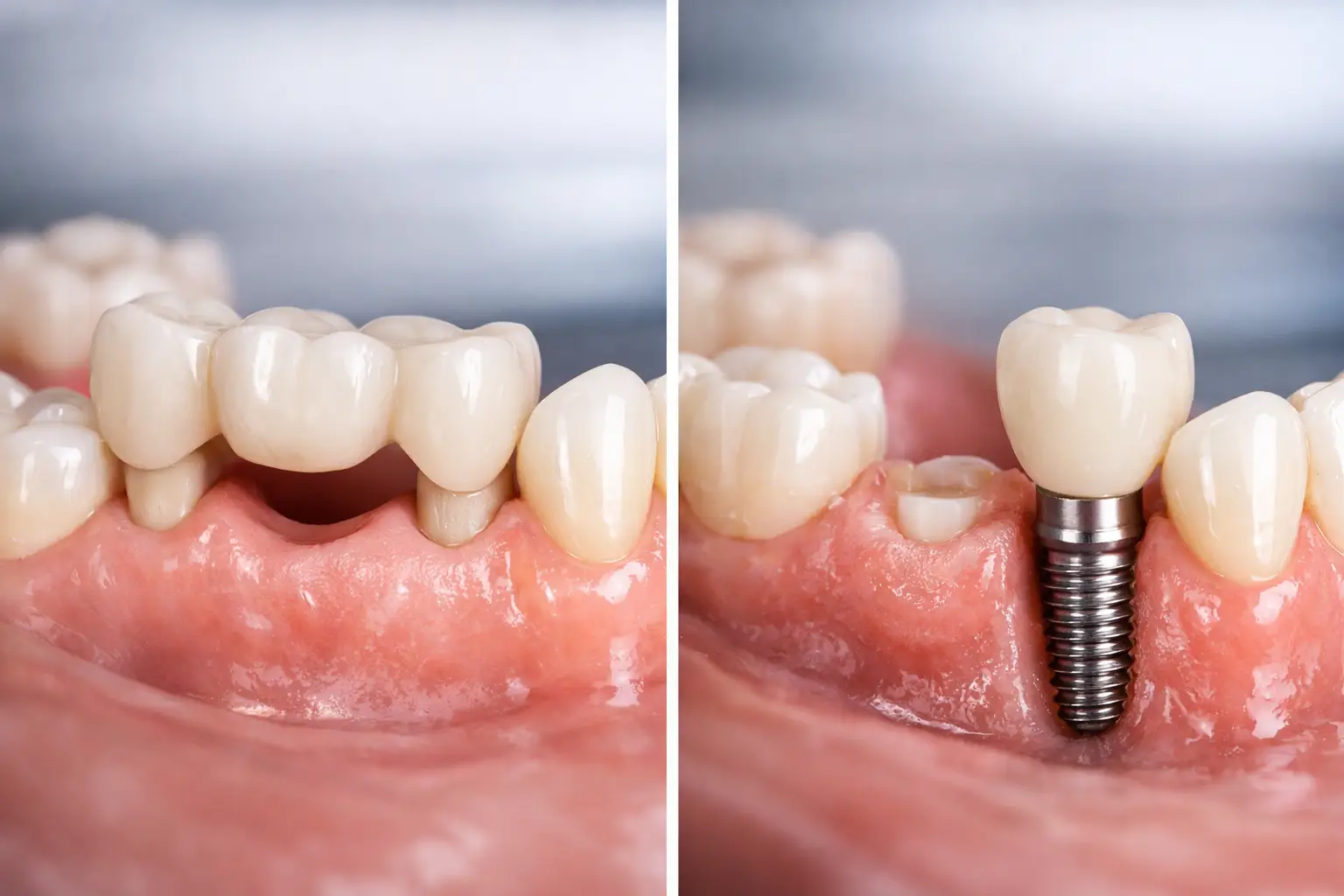
Losing one tooth can create more problems than most people expect. Chewing shifts, neighboring teeth start taking on extra stress, and that visible gap can affect how comfortable you feel smiling. If you are weighing a bridge vs implant for one missing tooth, the right choice depends on more than price alone. It comes down to your bone health, the condition of nearby teeth, your timeline, and what kind of long-term result you want.
At first glance, a bridge and a dental implant can both solve the same problem. They both fill the gap. They both restore function. They can both look natural when done well. But they work in very different ways, and those differences matter.
Bridge vs implant for one missing tooth: the basic difference
A dental bridge replaces the missing tooth by attaching an artificial tooth to the teeth on either side of the space. In many cases, those neighboring teeth are shaped down and covered with crowns so they can support the bridge.
A dental implant replaces the missing tooth at the root level. A small titanium post is placed into the jawbone, where it heals and integrates with the bone. After that, a crown is attached to the implant, creating a replacement tooth that stands on its own.
That distinction is the heart of the decision. A bridge relies on nearby teeth. An implant relies on the jawbone.
When a bridge makes more sense
A bridge can be an excellent option in the right case. If the teeth next to the missing tooth already need crowns because they are heavily filled, cracked, or worn down, using them to support a bridge may be very efficient. You are solving multiple problems in one treatment.
A bridge can also be a practical choice if you want a faster process. In many situations, a traditional bridge can be completed in a matter of weeks, while an implant may take several months from placement to final crown. If timing matters because of work, travel, or an upcoming event, that shorter timeline can be appealing.
Some patients also choose a bridge because they want to avoid surgery. Implant placement is a routine and predictable procedure, but it is still a surgical treatment. For people who are not comfortable with that idea, a bridge may feel more manageable.
There is also the financial side. The upfront cost of a bridge is often lower than an implant, though exact pricing varies based on insurance, materials, and whether additional procedures are needed.
When an implant is the better long-term choice
An implant is often considered the most conservative way to replace one missing tooth because it does not require grinding down healthy neighboring teeth. If the teeth next to the gap are in good shape, preserving them can be a major advantage.
Implants also help maintain bone in the area of the missing tooth. When a tooth root is gone, the jawbone in that spot no longer gets the stimulation it needs, and the bone can begin to shrink over time. A bridge restores the visible tooth, but it does not replace the root. An implant does.
That has cosmetic and functional benefits. Better bone support can help maintain the natural shape of the gums and jawline. It can also improve stability and chewing efficiency.
Longevity is another reason many patients prefer implants. A well-maintained implant can last for many years, often longer than a bridge. Bridges can also last a long time, but they are more dependent on the health of the supporting teeth. If one of those teeth develops decay, cracks, or gum issues, the entire bridge may be affected.
The trade-offs patients should understand
This is where the decision becomes personal. Neither option is automatically best for everyone.
A bridge is quicker and may cost less upfront, but it can require altering healthy teeth. It also does not prevent the bone loss that can happen under the missing tooth. Cleaning under a bridge takes some extra care as well, and not every patient finds that easy.
An implant protects adjacent teeth and supports the bone, but it usually takes longer and costs more at the beginning. It also requires enough healthy bone for placement. If there has already been bone loss, grafting may be recommended before or during implant treatment.
Medical history matters too. Some health conditions, smoking, uncontrolled diabetes, and certain medications can affect healing and implant success. That does not always rule out an implant, but it does mean treatment planning needs to be thorough.
What about appearance and comfort?
Most patients care about three things here: Will it look real, will it feel natural, and will it let me eat normally again?
Both bridges and implants can look excellent when planned carefully. Shade, shape, bite alignment, and gum contour all matter. An implant crown often feels the most like a natural tooth because it is independent and emerges through the gum much like a real tooth. A bridge can also look very natural, especially in areas that are less visible, but the esthetic result depends heavily on the health and shape of the surrounding teeth and gums.
Comfort can vary by person. Some patients like the simplicity of a bridge because treatment is shorter. Others prefer the feel of an implant because it functions more like an individual tooth. Once fully restored, many patients forget they even have an implant.
How dentists decide between a bridge and implant
A good recommendation is never based on one factor. It usually comes from a combination of exam findings, digital X-rays, bite analysis, and a conversation about your goals.
If the neighboring teeth are strong and untouched, an implant often has a clear advantage. If those teeth already need crowns, a bridge may become much more reasonable. If there is not enough bone for an implant and you do not want grafting, a bridge may be the simpler path. If you want the most tooth-conserving option and are comfortable with a longer timeline, an implant may be worth the investment.
This is why a one-size-fits-all answer tends to be misleading. The best treatment is the one that fits your mouth, your health, and your priorities.
Bridge vs implant for one missing tooth: cost and value
Patients often ask which option is cheaper. The honest answer is that a bridge usually costs less at the start, while an implant may offer better long-term value.
A bridge may need replacement sooner than an implant, especially if the supporting teeth develop problems. An implant has a higher initial fee, but because it stands alone and can last a very long time, many patients see it as a better investment over the years.
Insurance can also influence the decision. Some plans contribute more readily toward bridges than implants, though this varies widely. Financing options can make the implant route more manageable for patients who want the long-term benefits without paying everything upfront.
What if you have dental anxiety?
This matters more than people think. If past dental experiences left you nervous, you may lean toward whatever sounds less invasive. That is understandable, but fear should not force you into a treatment that is not ideal for your long-term oral health.
With modern techniques, local anesthesia, and gentle treatment planning, implant placement is often easier than patients expect. A bridge can also be comfortable, but it typically involves preparing the neighboring teeth, which is its own kind of commitment. The better question is not just which procedure sounds easier, but which option leaves you in the strongest position years from now.
For patients in Riverside who want a clear, pressure-free discussion of both options, Riverside Cosmetic Dentist and Dr. Ali Shmara focus on explaining treatment in plain language so you can make a confident decision based on comfort, appearance, function, and cost.
The decision most patients feel best about later
If you are choosing between treatments for one missing tooth, think beyond the next few weeks. Ask what happens to the surrounding teeth, the jawbone, and your bite over time. Ask how long each option is expected to last. Ask what maintenance looks like. And ask which option truly fits the current condition of your mouth.
A bridge is not a lesser treatment. In the right case, it is a smart and effective solution. An implant is not automatically necessary either. But when the neighboring teeth are healthy and bone support is good, many patients appreciate that an implant replaces the missing tooth without borrowing strength from the teeth next to it.
The best next step is a personalized exam, not guesswork. Once you know the condition of your bone, gums, bite, and adjacent teeth, the right answer usually becomes much clearer. Replacing a missing tooth is about more than closing a gap. It is about protecting the rest of your smile while making daily life feel normal again.